>yeah, you know what. you are just a filthy chronically online esl noob shitskinned ape who doesn't know how to communicate and be friendly, I know you are trying to ragebait me but you fucking suck balls at your job, I am NOT your fucking slave, but I am a Slave to God almighty. You need to get your priorities straight with your life you dummy. Trying to reason with you is just talking to a brick wall, You are a lost clause you know that? Nobody loves you in this world not even this website. As what LowTierGod has said, "Your life is nothing, you serve zero purpose, YOU SHOULD KILL YOURSELF, NOW!!"
  • Welcome. Registering and having your account be approved may take a while since there's only one guy checking and approving accounts and guestposts
  • Boards are being moved around and added. Leave feedback in this thread and let jannies move your threads

Orthodox icon gallery

Today (May 5th) we commemorate Saint Ephraim of Nea Makri
Άγιος Εφραίμ ο εν Νέα Μακρή (4).jpg
Άγιος Εφραίμ ο εν Νέα Μακρή.jpg
Η εύρεση του ιερού λειψάνου του Αγίου Εφραίμ της Νέας Μάκρης.jpg
 
1000016104.jpg
1000016105.jpg
1000016106.jpg
1000016107.jpg

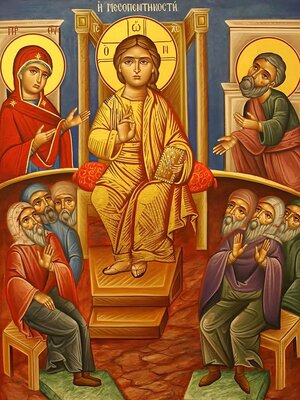
The Feast of Mid-Pentecost

Today, the fourth Wednesday following Holy Pascha which marks the halfway point of the 50 days between Pascha and Pentecost, is the feast of Mid-Pentecost. This feast is centred on the theme of Christ as Teacher, based on the events of John 7:14-39.

After the Saviour miraculously healed the paralytic (which we commemorated this past Sunday), the Jews, especially the Pharisees and Scribes, were moved with envy and sought to kill Christ, accusing Him of breaking the Law by performing this miracle on the Sabbath.

Christ later went to Jerusalem for the Feast of Tabernacles. John’s Gospel says that “about the middle of the feast Jesus went up into the temple and taught.” The Jews marvelled at the wisdom of His words, saying, “How does this Man know letters, having never studied?”

Jesus responded, “My doctrine is not Mine, but His who sent Me… He who speaks from himself seeks his own glory; but He who seeks the glory of the One who sent Him is true, and no unrighteousness is in Him.”

Christ then defended Himself before the Jewish religious leaders, saying, “Did not Moses give you the law, yet none of you keeps the law? Why do you seek to kill Me?” He also called out their hypocrisy in allowing circumcision on the Sabbath while objecting to His healing of the paralytic man.

Having spoken to them at length, proving that He is the Giver of the Law and equal to the Father, many came to believe in Him. Some of the people from Jerusalem exclaimed, “Look! He speaks boldly, and they say nothing to Him. Do the rulers know indeed that this is truly the Christ?”

On the last day of the feast, Jesus stood before the people and cried out, “If anyone thirsts, let him come to Me and drink. He who believes in Me, as the Scripture has said, out of his heart will flow rivers of living water.” His reference to the “living water” is ultimately a foretelling of the coming of the Holy Spirit on the day of Pentecost.

The feast of Mid-Pentecost is often represented by the icon of the 12-year-old Jesus conversing with the elders in the Temple following Passover (Luke 2:41-50), since this was the first biblical example of Christ as Teacher.
 
1000016108.jpg 1000016109.jpg 1000016110.jpg 1000016111.jpg 1000016112.jpg 1000016113.jpg


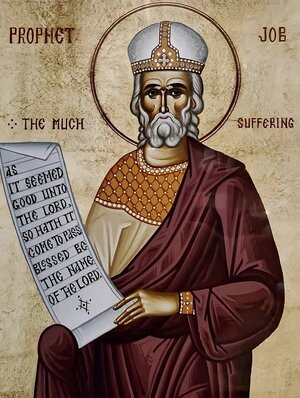
May 6 - The Righteous Job

Today, we commemorate the Righteous Prophet Job the Long-Suffering. Having lived 2000 years before Christ, Job (whose name means “persecuted”) was a 5th generation descendant of Abraham, and lived in the land of Uz between Idoumea and Arabia.

Job was a just and blameless man who abstained from every evil thing, and always strove to please God. The Lord rewarded his faithful servant, blessing him with 7 sons and 3 daughters, a large household, and an abundance of sheep, camels, oxen and donkeys.

Satan began to vilify Job before God: “Does Job fear God for nothing?… But now, stretch out Your hand and touch all that he has, and he will surely curse You to Your face!” To reveal how faithful Job was, and in order to teach people patience in their sufferings, God permitted Satan to take away all of his possessions.

One day, robbers came and drove away all Job’s cattle, slew his servants, and a tornado from the desert destroyed the house in which his children had gathered, killing them all. Job not only did not complain against God, but said: “God gave, and God hath taken away, blessed be the name of the Lord.”

Satan was put to shame, and again began to slander Job before God: “Stretch our your hand now, and touch his bone and his flesh (that is, strike him down with disease), and he will surely curse You to Your face!” God permitted Satan to deprive Job of his health, and he was struck with a most terrible disease of leprosy.

Even Job’s his wife bade him to complain against God. His friends, instead of offering consolation, only further grieved the innocent sufferer with their unjust shitoko But Job did not lose hope in God’s mercy, and he begged the Lord to testify that he was suffering in innocence.

In his discourse with his friends, Job also prophesied Christ: “I know that my Redeemer lives, and He shall stand at last on the earth; and after my skin is destroyed, this I know,
that in my flesh I shall see God” (Job 19:25-27).

After this, God rewarded His most faithful servant. Job regained his health, had 7 more sons and 3 more daughters, gained back twice as much cattle as before, and lived another 140 years.
 
1000016153.jpg
1000016154.jpg 1000016155.jpg
May 11 - Saints Cyril and Methodius the Apostles to the Slavs

Today, we commemorate Saints Cyril and Methodius, the Equals-to-the-Apostles and Enlighteners of the Slavs. These holy brothers preached the Gospel to the Slavic peoples in the 9th century, establishing the Orthodox faith throughout much of Eastern Europe.

Saints Cyril and Methodius were born Constantine and Michael around 826 AD, and came from an illustrious and pious family of Thessalonica. Well educated, and raised in an area where both Greek and Slavic speakers dwelt, they possessed great knowledge of both languages.

Michael was in the military and was governor in one of the Slavic principalities of the Byzantine Empire. After living there for 10 years, he was later tonsured a monk with the name Methodius at a monastery on Mt Olympus in Asia Minor (in modern day Uludag, Turkey).

Constantine studied with the emperor Michael III under the finest teachers in Constantinople, including St Photios the future Patriarch. Distinguished for his aptitude, he studied all the sciences and also knew several languages.

After completing his education, Constantine was ordained to the holy priesthood and was appointed curator of the patriarchal library at Hagia Sophia. He soon left the capital secretly and went to a monastery where he was tonsured a monk with the name Cyril.

In 860, recognizing the wisdom of the brothers, Emperor Michael Ill and Photius the Patriarch of Constantinople summoned them from the monastery, and sent them to preach the Gospel to the Khazars, a nomadic Turkic people in Eastern Europe.

Soon after, In 862, Prince Rastislav of Great Moravia, who was concerned of the growing influence of Frankish German priests preaching in the Latin language, asked the emperor to send missionaries who could bring the Gospel to the Slavic peoples in their own tongue.

Around 863, with the help of their disciples, the brothers devised the Glagolitic alphabet (the precursor to the Cyrillic alphabet, later named after Saint Cyril) in order to translate the sacred books needed for the divine services, including the Gospel, Epistles, Psalter, and liturgical texts.

After completing the translation, the brothers went to Moravia and began to teach the services in the Slavic language. By their missionary work and preaching, they brought many Slavic pagans to Christ.

Following complaints from the humiliated German bishops, the brothers were forced to defend the new liturgical language before the Pope of Rome Adrian II. The Pope greeted the brothers with honour, and permitted for divine services to be delivered in the newly devised Slavonic language.
St Cyril fell ill while in Rome and reposed there in 869.

The Pope consecrated St Methodius Archbishop of Moravia and Pannonia, and there he and his disciples continued to distribute services books written in the Slavonic language. This again aroused the wrath of the German bishops who had St Methodios arrested and sent in chains to Swabia where he endured deprivation and suffering for over 2 years.

After being set free by order of Pope John VIlI, St Methodios continued to preach the Gospel among the Slavs. He baptized the Czech prince Borivoi and his wife Ludmilla, and also one of the Polish princes. The German bishops began to persecute the saint again because he did not accept the erroneous Latin teaching about the procession of the Holy Spirit (the Filioque).

St Methodios was again summoned to Rome, but he justified himself before the Pope, and preserved the Orthodox teaching in its purity, and was sent again to the capital of Moravia, Velehrad. Here, for the remaining years of his life, St Methodios, assisted by two of his former pupils, translated much of the Old Testament into Slavonic.

With his health having deteriorated after such extensive travels and tireless missionary work, the holy bishop St Methodius reposed in 885. The Saint's burial service was chanted in 3 languages:
Slavonic, Greek, and Latin. He was buried in the Cathedral Church of Velehrad.

Bulgaria, North Macedonia and Russia observe a celebratory day for Saints Cyril and Methodius on May 24, commemorating their contributions to Slavic literature, culture, and Orthodoxy. The Czech Republic and Slovakia observe the national holiday of "Sts Cyril and Methodius Day" on July 5th.

 
Back
Top Bottom