>Sickening vomit inducing image. I would rather be force fed a chimpanzee's rotting asshole than see this image again. I would rather drown in elephant shit in Bangladesh
  • Welcome. Registering and having your account be approved may take a while since there's only one guy checking and approving accounts and guestposts
  • Boards are being moved around and added. Leave feedback in this thread and let jannies move your threads

Orthodox icon gallery

View attachment 130789
View attachment 130791View attachment 130792
May 11 - Saints Cyril and Methodius the Apostles to the Slavs

Today, we commemorate Saints Cyril and Methodius, the Equals-to-the-Apostles and Enlighteners of the Slavs. These holy brothers preached the Gospel to the Slavic peoples in the 9th century, establishing the Orthodox faith throughout much of Eastern Europe.

Saints Cyril and Methodius were born Constantine and Michael around 826 AD, and came from an illustrious and pious family of Thessalonica. Well educated, and raised in an area where both Greek and Slavic speakers dwelt, they possessed great knowledge of both languages.

Michael was in the military and was governor in one of the Slavic principalities of the Byzantine Empire. After living there for 10 years, he was later tonsured a monk with the name Methodius at a monastery on Mt Olympus in Asia Minor (in modern day Uludag, Turkey).

Constantine studied with the emperor Michael III under the finest teachers in Constantinople, including St Photios the future Patriarch. Distinguished for his aptitude, he studied all the sciences and also knew several languages.

After completing his education, Constantine was ordained to the holy priesthood and was appointed curator of the patriarchal library at Hagia Sophia. He soon left the capital secretly and went to a monastery where he was tonsured a monk with the name Cyril.

In 860, recognizing the wisdom of the brothers, Emperor Michael Ill and Photius the Patriarch of Constantinople summoned them from the monastery, and sent them to preach the Gospel to the Khazars, a nomadic Turkic people in Eastern Europe.

Soon after, In 862, Prince Rastislav of Great Moravia, who was concerned of the growing influence of Frankish German priests preaching in the Latin language, asked the emperor to send missionaries who could bring the Gospel to the Slavic peoples in their own tongue.

Around 863, with the help of their disciples, the brothers devised the Glagolitic alphabet (the precursor to the Cyrillic alphabet, later named after Saint Cyril) in order to translate the sacred books needed for the divine services, including the Gospel, Epistles, Psalter, and liturgical texts.

After completing the translation, the brothers went to Moravia and began to teach the services in the Slavic language. By their missionary work and preaching, they brought many Slavic pagans to Christ.

Following complaints from the humiliated German bishops, the brothers were forced to defend the new liturgical language before the Pope of Rome Adrian II. The Pope greeted the brothers with honour, and permitted for divine services to be delivered in the newly devised Slavonic language.
St Cyril fell ill while in Rome and reposed there in 869.

The Pope consecrated St Methodius Archbishop of Moravia and Pannonia, and there he and his disciples continued to distribute services books written in the Slavonic language. This again aroused the wrath of the German bishops who had St Methodios arrested and sent in chains to Swabia where he endured deprivation and suffering for over 2 years.

After being set free by order of Pope John VIlI, St Methodios continued to preach the Gospel among the Slavs. He baptized the Czech prince Borivoi and his wife Ludmilla, and also one of the Polish princes. The German bishops began to persecute the saint again because he did not accept the erroneous Latin teaching about the procession of the Holy Spirit (the Filioque).

St Methodios was again summoned to Rome, but he justified himself before the Pope, and preserved the Orthodox teaching in its purity, and was sent again to the capital of Moravia, Velehrad. Here, for the remaining years of his life, St Methodios, assisted by two of his former pupils, translated much of the Old Testament into Slavonic.

With his health having deteriorated after such extensive travels and tireless missionary work, the holy bishop St Methodius reposed in 885. The Saint's burial service was chanted in 3 languages:
Slavonic, Greek, and Latin. He was buried in the Cathedral Church of Velehrad.

Bulgaria, North Macedonia and Russia observe a celebratory day for Saints Cyril and Methodius on May 24, commemorating their contributions to Slavic literature, culture, and Orthodoxy. The Czech Republic and Slovakia observe the national holiday of "Sts Cyril and Methodius Day" on July 5th.

image%20(1).png
 
1000016168.jpg 1000016169.jpg 1000016170.jpg 1000016171.jpg

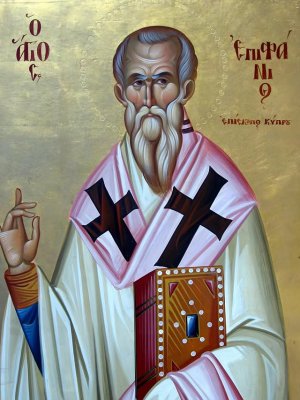
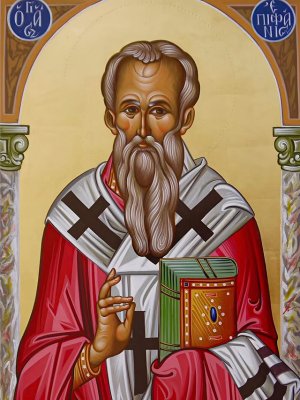
May 12 - Saint Epiphanios of Cyprus 🇨🇾

Today we commemorate Saint Epiphanios, Archbishop of Cyprus.

St Epiphanios was born in 310 in the village of Besanduk in Palestine to a poor family of Jewish farmers. His parents remained in the shadow and worship of the Law, but the pious and God-pleasing Epiphanios was blessed to see the light of the Christian faith.

When the future saint was beginning to have some doubts regarding the old Law, he saw a certain monk named Lucian give away his clothing to a poor man. Struck by the monk’s compassion, Epiphanios asked to be instructed in Christianity.

After his baptism, he became a monk at a monastery in Egypt under the spiritual guidance of St Hilarion the Great. As he progressed in the monastic life, he occupied himself copying Greek books, and performed many miracles and healings - as many for the soul as for the body.

To avoid praises and human glory, Epiphanios went deep into the desert. Here, a band of robbers snatched and held him tor 3 months, but he brought one of them to Christ by preaching repentance, and was subsequently set free. This robber was baptised with the name John, and became his disciple at the monastery.

Returning to the wilderness of Palestine in 333, Epiphanios again sought the ascetic life with his disciple John. As the reputation of his holiness spread, more disciples came to Epiphanios. He founded a monastery where he was ordained a priest, and served as the Abbot for 30 years.

In 367, Epiphanios was elevated by a council as the Bishop of Salamis in Cyprus, and in this position he was embroiled in the various heresies of the time. He participated in the synod of 376 in Antioch where he defended Orthodoxy against the heresy of Apollinarianism.

In 403, St Epiphanios was summoned to Constantinople to participate in the Synod of the Oak, which was convened to depose St John Chrysostom. Once Epiphanios realized that he was being manipulated by Chrysostom’s enemies, he left Constantinople, unwilling to take part in an unlawful council.

On his return to Salamis, St Epiphanios reposed in 403 at an old age. He is known for composing the Panarion, a compendium of 80 heresies.
 
  • Like
Reactions: CX2
May 14th - Saint Therapon 🇨🇾
Today we commemorate Saint Therapon. Saint Therapon lived a life of asceticism, became a monk, and was later elevated to the rank of bishop on the island of Cyprus, specifically on the city of Kition (modern-day Larnaca). He was persecuted under the rule of Emperor Diocletian in the 4th century AD.
1000016188.jpg 1000016189.jpg
 
Last edited:
May 14th - Saint Therapon 🇨🇾
Today we commemorate Saint Therapon. Saint Therapon lived a life of asceticism, became a monk, and was later elevated to the rank of bishop on the island of Cyprus, specifically on the city of Kition (modern-day Larnaca). He was persecuted under the rule of Emperor Diocletian in the 4th century AD.
View attachment 131476View attachment 131477
1000015973.jpg
 
Last edited:
1000016320.jpg
1000016322.jpg
1000016324.jpg
1000016328.jpg
1000016327.jpg
1000016321.jpg 1000016323.jpg 1000016325.jpg
1000016326.jpg
May 27 - Saint John the Russian 🇷🇺

Today, we commemorate the Holy Confessor Saint John the Russian.

St John was born in 1690 in Little Russia, and was raised with love for the Church. Upon reaching the age of maturity, he was called to serve in the army of Tsar Peter the Great during the Russo-Turkish War.

During the Prutsk Campaign of 1711, he was captured and handed over to the Agha of the Turkish cavalry who took him to his home village of Prokopi in Cappadocia (today Ürgüp, Turkey) to be his slave. John’s master tried persistently to convert him to Islam - firstly through flattery, and then with threats, beatings and torture.

St John firmly resisted his master saying: “You cannot turn me from my holy Faith by threats, nor with promises of riches and pleasures. I will obey your orders willingly, if you will leave me free to follow my religion. I would rather surrender my head to you than to change my faith. I was born a Christian, and I shall die a Christian.”

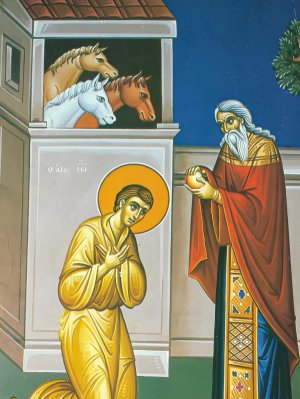
After time however, his master’s heart was softened by the meekness and humility of his servent. John was assigned to take care of his master’s animals, and lived among them in the stable. He rejoiced that his bed was a manger just like where Christ was born. In the cold winters and summer heat, St John obediently fulfilled all of his master’s orders.

While keeping a strict fast, he chanted the psalms in his stable, shared what little food he had with the poor, comforted his fellow slaves, and helped the sick and the needy. When night came, he would go in secret to the nearby cave-church of St George.

His master soon became one of the most wealthy and powerful men in Prokopi, and he attributed his blessings to the holy man who lived in his household. The master and his wife came to love John, and they offered him a small room near the hayloft. But John did not accept it, preferring to remain in the humble stable with the animals.

After falling ill, John summoned a priest in order to receive Holy Communion. The priest, fearing the Turkish officer, concealed the Holy Mysteries in an apple, and brought them to St John. Having communed, St John delivered his soul on May 27, 1730.
 
  • Like
Reactions: CX2
Back
Top Bottom